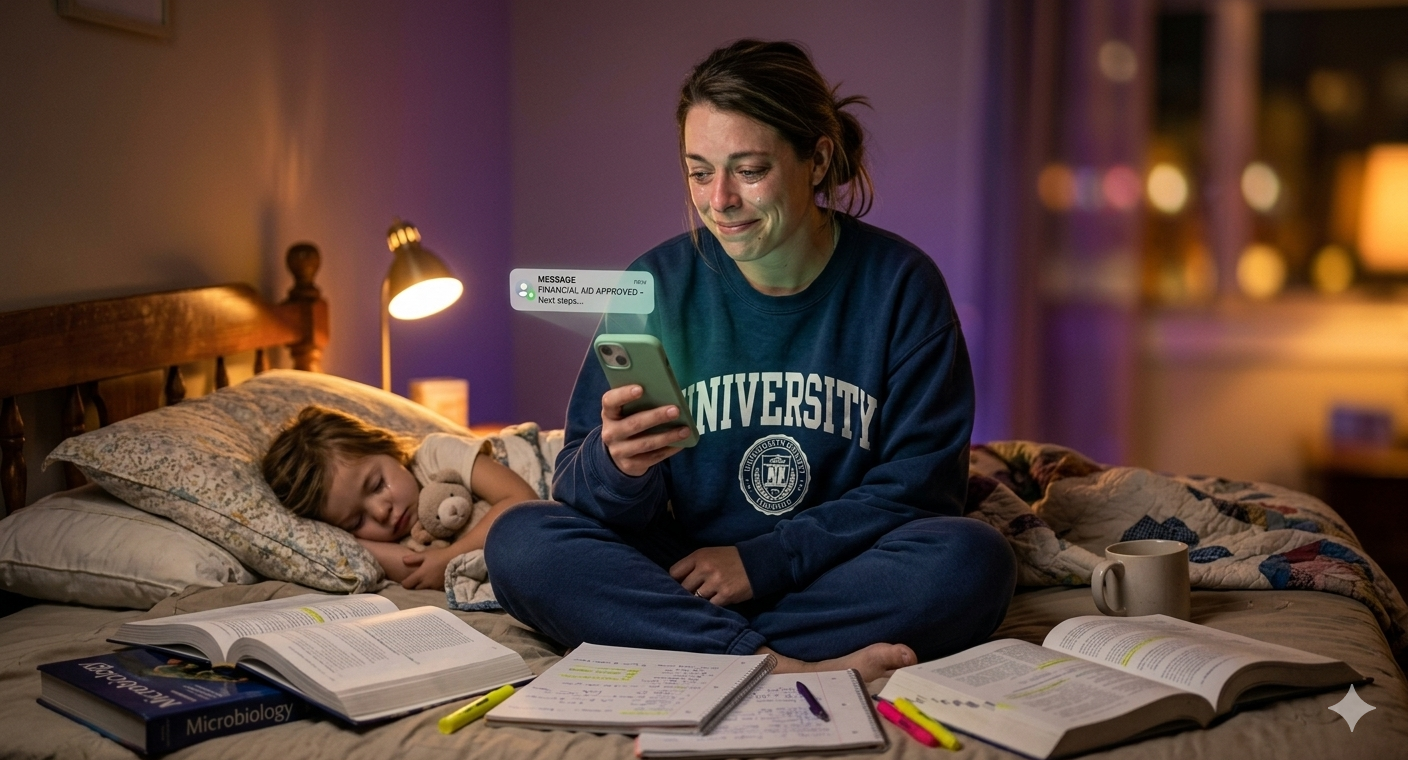
Picture this. It is 11pm on a Tuesday. The kid is finally asleep. Laptop open, cold cup of tea beside it, and a browser tab full of tuition costs that makes your stomach drop. Going back to school feels necessary maybe even urgent. But every single number on that screen looks impossible on one income.
I have been in that exact spot. And I wish someone had just told me plainly: there is money set aside for exactly this situation, it does not need to be paid back, and you very likely qualify for it.
The program is called the Federal Pell Grant. Unlike student loans, it never needs to be repaid. And it does not care that you are doing this alone — for single moms, this grant is often the difference between a college degree staying a dream and actually becoming a reality.
This guide covers everything — what it is, whether you qualify, how much you can get, and exactly how to apply. No jargon, no runaround. Just the straight version from someone who has been through it.
What is the federal Pell Grant
The Federal Pell Grant is the largest source of free college money the U.S. government offers. Free means free it is not a loan, it does not accrue interest, and in almost all cases you never pay it back. It goes directly toward your education costs.
It was designed specifically for students with financial need. And here is the thing nobody tells you clearly enough: single moms are almost always considered high-need. The system was not built against you. In many ways, it was built for people in exactly your position.
The grant amount you receive depends on your financial need, how much school costs where you are enrolled, and whether you are attending full-time or part-time. That means the number is different for everyone but the fact that it is free money stays the same no matter what you receive.
This is the grant most single moms rely on when going back to school. And it is the first thing you should know about before you spend a single minute looking at student loans.
The Pell Grant is awarded per academic year, and you need to reapply every year through FAFSA. It does not automatically renew. Set a reminder this is one deadline you cannot afford to miss.
Can single moms get a federal Pell Grant?
Yes, and here is something you need to know right up front, because I see this confusion everywhere: there is no special Pell Grant exclusively for single moms. It is not a program created just for you. It is a need-based grant open to any eligible student in the United States.
But here is the part that actually matters: single moms qualify for more aid more easily than almost any other type of student. The way the system calculates financial need almost always works in your favor. Here is why.
| Factor | How It Works for Single Moms | Why It Helps |
|---|---|---|
| Independent Student Status | As a single mom, you are automatically considered an independent student | Your parents’ income is never counted – only yours |
| Household Size | Your children count as part of your household | Larger households = lower Student Aid Index = more grant money |
| Single Income | You report only your own earnings | No second income inflating your financial picture |
| No Partner Assets | Only your assets are counted, not a partner’s savings or investments | Lower total assets = higher financial need |
When I filled out my FAFSA, I honestly expected to be told I made too much. I was working full-time and thought that disqualified me. But the formula does not just look at what you earn. It looks at your whole situation what you earn, how many people depend on that income, what you have saved, and what school actually costs. When you are supporting children on your own, that picture almost always shows real financial need.
Pell Grant eligibility for single mothers
Basic Requirements
Before the numbers matter, you need to check the basic boxes. These are the non-negotiable starting points:
- You are a U.S. citizen or an eligible non-citizen (including certain permanent residents and visa holders)
- You have a high school diploma, GED, or completed homeschool equivalent
- You are enrolled or accepted into an eligible degree or certificate program at an accredited school
- You are not in default on any existing federal student loans
- You have not already used up your 12 semesters of Pell Grant eligibility
- You demonstrate financial need based on your FAFSA results
Income limits – What you actually need to know
This is where most single moms get confused, and I want to be very clear: there is no fixed income cutoff for the Pell Grant. There is no number where you earn one dollar over and automatically get nothing. The system does not work that way.
What the government uses is called the Student Aid Index (SAI) it is a number calculated from your FAFSA that represents your estimated ability to pay. The lower your SAI, the more grant money you can receive. A SAI of zero means you qualify for the maximum award.
A single mom with two kids and a household income of around $45,000 a year can still qualify for close to the maximum Pell Grant award.
The combination of independent status, household size, and a single income keeps the Student Aid Index low enough for significant aid. Do not assume you earn too much without actually filling out the form.
Why single moms qualify for more money
Let me break down the mechanics simply. When FAFSA calculates your SAI, it considers your income after deductions, your assets, and your family size. As a single mom:
Your household is larger than a single student with no children — more dependents means the formula assumes more of your income is already committed to basic living costs, so less is considered “available” for school.
With only one income to report, there is no partner’s salary, no combined savings account, no second set of assets pulling your SAI higher.
The independent student status means the calculation starts fresh from your situation alone not your parents’ financial picture, which often hurts younger students significantly.
The result is almost always a lower SAI, which translates directly into more grant money in your pocket.
How much can a single mom get from the Pell Grant?
The maximum Pell Grant award for the 2025–2026 academic year is $7,395. That is per year, not per semester though it is typically split across your semesters of enrollment.
Your actual award will depend on your SAI, your school’s cost of attendance, and whether you are enrolled full-time or part-time. Here is what that generally looks like in practice:
Here is something that genuinely surprised me when I went through this: if you attend a community college, the Pell Grant can cover your tuition entirely and sometimes leave money left over for books, supplies, and other education-related expenses.
Community college tuition at many institutions runs between $3,000 and $5,000 a year for full-time students. If your Pell Grant award comes in at $6,000 or more, that difference does not disappear. The remaining funds go toward what your school calls your “cost of attendance” which can include housing, transportation, childcare costs, and course materials. That is real money that can ease your life while you study.
The Pell Grant can also be combined with other forms of aid state grants, scholarships, and work-study programs. Getting the Pell Grant does not disqualify you from anything else. It is the foundation, not the ceiling.
How to apply for the Pell Grant: step by step
The six steps to complete your FAFSA
There is no separate application for the Pell Grant. You apply through the FAFSA the Free Application for Federal Student Aid and the system automatically considers you for the Pell Grant based on your results. Here is exactly how it works:
Practical tip
Apply the day the FAFSA opens if you can. October 1st is not a rumor some institutional grants are literally awarded until they run out of funds. The Pell Grant itself is federally funded and not limited, but every additional dollar of aid you might qualify for through your state or school often is. Early application costs you nothing and could gain you significantly more.
What happens after you submit
Most students hear back within three to five business days via email. Your Student Aid Report (SAR) will arrive first review every line for errors. After your school processes your FAFSA, your full financial aid offer follows. That is when you will see your actual Pell Grant award amount in writing.
Do you have to pay back a Pell Grant?
No. Not a Loan In almost every situation, you never pay back a single dollar of your Pell Grant. That is what makes it different from student loans, which follow you around for years after graduation. The Pell Grant is yours to keep.
That said, there are two narrow situations where you might owe money back. I want to be honest about them because nobody should be surprised:
- You withdraw from school early in the semester. If you drop out before completing a certain percentage of the semester (usually 60%), the school may be required to return a portion of your grant to the government. This does not always mean you personally owe money the school handles it, but it can affect your future eligibility. If you are going through a hard time, talk to your financial aid office before you withdraw. There are often options.
- You received an overpayment by mistake. If an administrative error resulted in you receiving more than you were entitled to, you may need to return the excess amount. This is rare and the school will notify you if it happens.
Outside of those two specific scenarios: the Pell Grant is free money. You earned it by being exactly who you are. a student with financial need, doing what it takes to build a better future for your family. There is no catch beyond that.
Other grants and aid for single moms
The Pell Grant is the foundation, but it is not the only money available to you. Once you have your FAFSA filed, you automatically become eligible for several other federal and state programs. Here is where to look next:
| Program | Who Provides It | What It Covers |
|---|---|---|
| Federal Supplemental Educational Opportunity Grant (FSEOG) | Federal government, distributed through schools | $100 to $4,000 per year for students with exceptional need Pell Grant recipients are first priority |
| State Grants | Your state’s higher education agency | Varies by state many have dedicated grants for low-income parents returning to school |
| Institutional Grants | Your specific college or university | Many schools have their own need-based funds ask your financial aid office directly |
| Scholarships for Mothers | Private organizations, foundations, nonprofits | Range from a few hundred to several thousand dollars worth searching specifically |
The FSEOG in particular is worth knowing about. It is specifically for students with exceptional financial need, and Pell Grant recipients get first priority. You do not apply separately your school determines eligibility from your FAFSA. But you do need to apply early, because this grant is funded directly to schools in limited amounts.
For state-specific programs, your state’s higher education commission website is the best place to start. Many states have grants specifically designed for parents returning to school, single-parent households, or students in particular career fields like nursing, education, or social work.
According to Federal Student Aid (studentaid.gov), the FAFSA opens eligibility for all federal grants, work-study, and loans in a single application one form, maximum coverage. It is the most efficient thing you can do financially for your education.
A real example: what this looks like in practice
When I first sat down to look at going back to school, I had a four-year-old and a job that paid just enough to cover rent, daycare, groceries, and not much else. I had looked at the tuition page for the local community college and closed the tab immediately. I literally thought: “That’s not for people like me right now.”
A friend in a single mom support group told me to just fill out the FAFSA before making any decisions. I put it off for three weeks because I was convinced I would be rejected and I did not want to feel that. Finally, on a quiet Sunday afternoon while my daughter napped, I sat down and did it.
My SAI came back at zero. I did not fully understand what that meant until the financial aid offer arrived from the community college a few weeks later. The Pell Grant covered my tuition completely. The FSEOG covered my books. There was even a small amount left over that went toward my transportation costs for the semester.
I paid nothing out of pocket for my first year of college. I cried in my kitchen when I realized that. Not from relief, honestly from embarrassment that I had almost talked myself out of even trying.
File the FAFSA. Let the form tell you what you qualify for. Do not decide for yourself that the answer is no.
A single mom who almost didn’t apply
Stories like this are not rare. They happen every semester at community colleges and universities across the country. The system is genuinely set up to make college accessible for people in financial need and single moms with children at home represent exactly the situation the Pell Grant was designed to help.
Common mistakes that cost single moms free money
I have seen these happen over and over in the single mom communities I have been part of. Every one of these mistakes is avoidable, and every one of them has a cost:
Before you even apply
-
⚠️Assuming your income is too high without checking. The most expensive assumption you can make. FAFSA is the only way to actually know your SAI. Skipping the application because you think you will not qualify means leaving potentially thousands of dollars on the table every year. The form takes about 30 minutes. File it.
-
⚠️Missing the FAFSA deadline. The federal deadline is generous usually June 30th of the current academic year but many states and schools have their own earlier deadlines. Apply in October or November if you can. Some state grants disappear before spring.
-
⚠️Not reapplying every year. I know someone who got the grant her first year and then forgot to resubmit FAFSA. She found out mid-semester that her financial aid had not been renewed. The stress was enormous and completely avoidable. Set a calendar reminder for October 1st, every year.
Once you are enrolled
-
⚠️Enrolling less than half-time without realizing the impact. Taking fewer credits per semester is completely valid life as a single mom does not always allow for a full load. But be aware that your Pell Grant award will be reduced proportionally. Plan your enrollment with that in mind.
-
⚠️Stopping at the Pell Grant and not looking for more. FAFSA opens doors beyond the Pell Grant state grants, the FSEOG, institutional aid, work-study. Once you submit your FAFSA, your financial aid office can walk you through everything you qualify for. Ask specifically. Some aid requires an extra step or form, and offices do not always proactively tell you.
-
⚠️Accepting student loans in your financial aid package without question. Student loans will often appear in your award letter alongside grants. They are not free money they must be repaid with interest. Only accept loan amounts if you genuinely need them after grants and scholarships. You are allowed to accept partial loans or decline them entirely.
According to research from the American Academy of Pediatrics and various education policy groups, parental education level remains one of the strongest predictors of child outcomes in health, income, and stability. Going back to school is one of the highest-impact things you can do for yourself and for your kids. Do not let a paperwork mistake be what stops you.
Frequently asked questions
Do single moms automatically qualify for the Pell Grant?
Not automatically eligibility is still based on financial need as calculated by FAFSA. But single moms have a significantly higher chance of qualifying, and qualifying for a large award, compared to most other student types. Independent status, household size, and single income all push the Student Aid Index lower, which means more grant money. The only way to know for certain is to file your FAFSA.
What income is too high to get the Pell Grant?
There is no fixed income cutoff. Eligibility depends on your Student Aid Index, which considers your income alongside your family size, assets, and cost of attendance. A single mom with two children earning $45,000 a year may still qualify for a significant award. Do not let a number in your head stop you from filing let the FAFSA tell you the real answer.
Can I get the Pell Grant and other financial aid at the same time?
Yes. The Pell Grant can be combined with the FSEOG, state grants, institutional scholarships, private scholarships, and work-study. Receiving the Pell Grant does not reduce your eligibility for other aid in many cases it actually improves it, because Pell Grant recipients get priority consideration for programs like the FSEOG.
Can I use the Pell Grant for online programs?
Yes. As long as the school and program are accredited and eligible for federal financial aid, online enrollment qualifies. Many single moms find online or hybrid programs much more manageable with childcare responsibilities, and the Pell Grant covers them exactly the same way it covers in-person courses.
What happens to my Pell Grant if I drop a class?
Your enrollment status directly affects your award amount. If you drop below half-time, your award is reduced proportionally. If you drop below a certain attendance threshold within a semester, your school may be required to return a portion of your grant funds. Talk to your financial aid office before dropping any class they can often help you find alternatives like a late withdrawal or an incomplete grade that protect your aid.
How long can I receive the Pell Grant?
You have 12 semesters or 6 full academic years of Pell Grant eligibility over your lifetime. This is called your Pell Grant Lifetime Eligibility Used (LEU). If you attended college before and received the Pell Grant then, those semesters count toward your limit. You can check your remaining eligibility at studentaid.gov.
Why do some people not qualify for the Pell Grant?
The most common reasons are: Student Aid Index is too high (usually when household income and assets are above a certain threshold relative to family size), the student is not enrolled in an eligible program, they have already used their 12 semesters of eligibility, or they have a federal student loan in default. If you are not sure why you did not qualify, your financial aid office can walk through your FAFSA results with you. According to Federal Student Aid, there are also appeals processes if your circumstances have changed significantly since filing.
You Have Already Done the Hardest Part
Deciding you want more for yourself and your kids that part took courage. Everything else is paperwork.
The FAFSA takes about 30 minutes. The Pell Grant, if you qualify, can be worth thousands of dollars every year. And for single moms especially, the math almost always works out in your favor.
Go to studentaid.gov. Create your account. Start the application. Let the form give you the real answer instead of the one fear makes up for you.
You are not asking for charity. You are claiming what the system built for people in exactly your situation.
With love, OurNewborn ♡
References and further reading
The information in this guide is based on current federal financial aid guidelines and verified sources. For additional reading and official documentation:
National Association of Independent Colleges and Universities
naicu.edu Pell Grant Policy Brief : Research and policy analysis on Pell Grant award trends, lifetime eligibility, and the impact on first-generation and low-income students.
Federal Student Aid Official Pell Grant Information
studentaid.gov/understand-aid/types/grants/pell : The official U.S. Department of Education page covering Pell Grant eligibility, award amounts, and FAFSA application process.
U.S. Department of Education FSA Handbook
fsapartners.ed.gov : The complete federal guidelines on student eligibility for Pell Grants, including rules around independent student status and household size calculations.